
A curiosity that few people know about and causes perplexity among the most attentive frequenters of the Gavia is related to its actual elevation above sea level.
Arriving at the Gavia Pass still today the sign shows the elevation 2652 meters above sea level, in reality at that point one is exactly at “only” 2621 meters.
There are those who cry “to the scam,” as if to raise the bar, which given its considerable altitude in our judgment there is no need for. In the interest of fairness, however, it should be said that the reported quota is not exact, or at least as of today it is no longer correct. We explain the reason for this apparent contradiction.
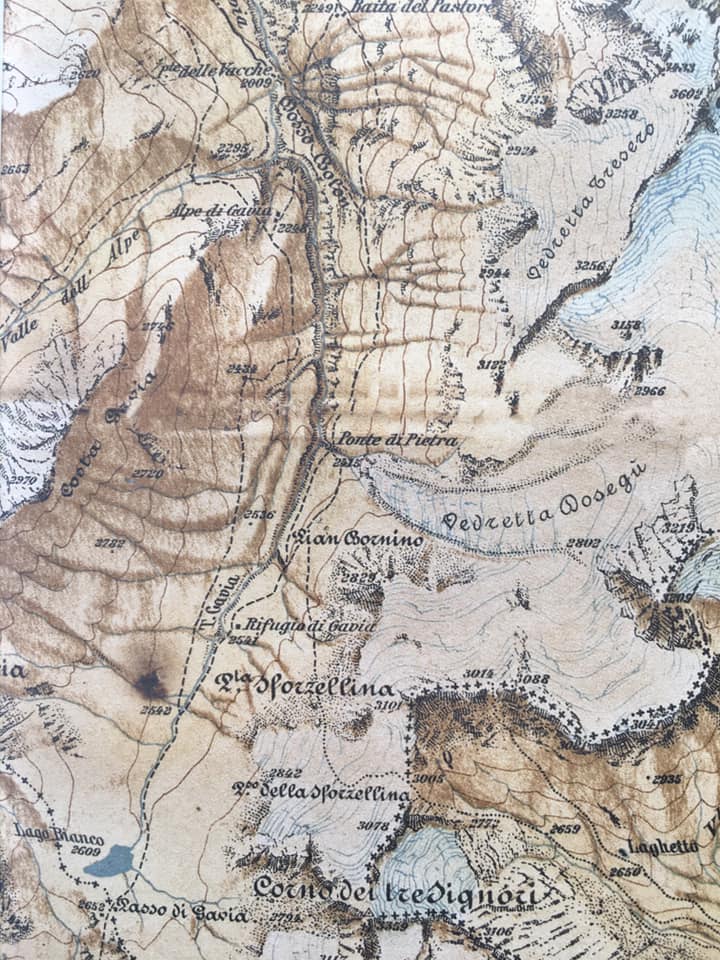

These two maps were made in the early 1900s.
The first is designed by Luigi Brasca based on surveys and directions by Aldo Bonacossa in 1914, drawn at the request of the Kingdom of Italy just before the outbreak of the Great War. State boundaries, what are now simply regional boundaries, are indicated.
The second, on the other hand, is touristic and is designed by Giuseppe Galli for the Italian Alpine Club section of Milan, again before the outbreak of the Great War.
The carriage road at that time ended at Santa Caterina da Bormio and at Sant’Apollonia da Ponte di Legno, but in fact the connection certainly existed as far back as the Middle Ages, and in good likelihood even from previous centuries.
Going up from Santa Caterina, there was an old mule track that led to Plaghera and then a path that followed a different route in some places than today’s road, at least as far as Pian Bormino, but at its end, instead of skirting Lake Bianco and arriving at the lowest possible point, as the rule would have it, the road kept quite a ways toward Mount Gaviola and then descended into Valle delle Messi higher up, exactly at 2652 meters above sea level. A very rough and fearsome descent by the way, the one in the Valle delle Messi: getting to the bottom of the St. Apollonia plain was definitely arduous.
Once war broke out, the needs to quickly bring materials, supplies and Alpine troops from the Adamello to the Ortler/Cevedale led with great ingenuity to the birth of today’s Gavia Pass military road. The Alpini, however, once they arrived near the pass, decided for convenience and greater simplicity to take advantage of the lowest possible point to make the pass transit, and so the new altitude of the Gavia Pass dropped to 2621 meters.
If you still see signs that say “2652m” it is not a “scam,” it is the history of the Gavia of days gone by, when for many centuries the point of the summit was different from where it is today.